

The clinical blind spot
A patient says, “I can see fine in the exam room, but I can’t drive at night.”
Too often, that complaint is attributed to normal aging, early cataract, or anxiety, particularly when acuity is good and imaging appears reassuring. Yet low-light difficulty may reflect impaired retinal function that is not captured by a conventional structure-focused workflow.
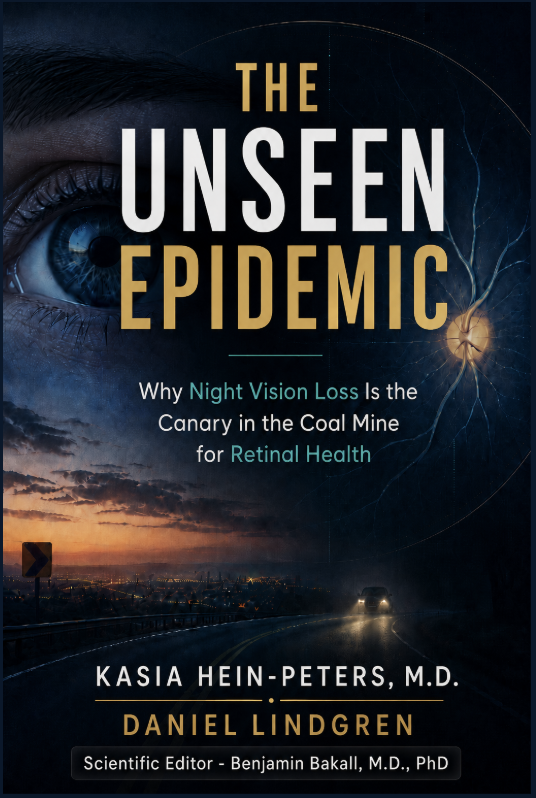
The Unseen Epidemic makes the case for listening differently and measuring what imaging alone cannot: how the retina recovers and performs in the dark.
This is not a call to replace OCT, fundus photography, or specialty referral, but to add the functional layer that helps complete the clinical picture.
From symptom to measurable insight
Night vision matters because it affects safety, mobility, independence, and quality of life. Patients may quietly stop driving at dusk, avoid restaurants and theaters, or become fearful of walking in dim environments long before they describe themselves as having a “vision problem.”
This book provides a better clinical response than reassurance alone:
“Your eyes may look healthy on imaging, but let’s assess how your retina is functioning in low light.”
By turning a subjective complaint into an objective measurement, clinicians can establish a baseline, identify functional change, and make more informed decisions about next diagnostic and therapeutic steps.
What you will learn
This book translates retinal science into an accessible, clinic-ready framework. You will learn how to:
- Recognize night-vision loss as a clinically meaningful symptom rather than a vague complaint.
- Understand why rod-mediated dark adaptation can be affected before visible structural changes appear.
- Identify appropriate candidates for functional assessment, including older adults, patients with diabetes, those with a family history of retinal disease, patients taking potentially retinotoxic medications, and people who avoid night driving.
- Perform and interpret dark-adaptation testing, including how to recognize normal, borderline, and abnormal recovery patterns.
- Use functional findings to guide follow-up, additional testing, patient counseling, monitoring, and referral.
- Manage difficult clinical scenarios, including persistent symptoms with normal testing and equivocal results.
- Integrate dark-adaptation testing into your practice workflow.
Built for real-world practice
The Unseen Epidemic addresses the questions every practice owner and clinician asks before adopting a new diagnostic approach:
- Will it fit the workflow? Wearable dark-adaptation testing can be performed by trained staff and integrated into an exam-room workflow.
- What does the result mean? The book offers practical interpretation guidance and decision pathways rather than theory alone.
- Who should be tested first? It gives a clear starting population and a simple implementation plan.
- Is there an economic rationale? The book examines coding, appropriate diagnostic use, repeat monitoring, and the role of functional testing in building a differentiated, proactive retinal-care service.
More than a diagnostic book
This is a book about a shift in clinical mindset.
It asks primary eye care professionals to move from waiting for retinal disease to declare itself to recognizing early functional warning signs while there is still time to investigate, intervene, monitor, and refer appropriately.
You do not need to become a retina specialist to make a difference. You need a framework for recognizing the patient whose visual acuity and imaging do not fully explain their lived experience.
The Unseen Epidemic gives you that framework.
Who should read it
This book is written for:
- Optometrists providing comprehensive medical eye care.
- General ophthalmologists.
- Practice owners evaluating new diagnostic services.
- Residents and students developing a prevention-oriented approach to retinal care.
- Technicians and clinical leaders who support retinal testing workflows.
- Any clinician who has heard, “I don’t feel safe driving at night,” and wanted a more meaningful next step.
About the authors
Kasia Hein-Peters, MD brings medical, pharmaceutical, and medtech leadership experience to the challenge of earlier retinal-dysfunction detection. Her work is rooted in a personal understanding of the real-world consequences of vision loss and a commitment to prevention-oriented eye care.
Daniel Lindgren is a longtime innovator in ophthalmic diagnostics, imaging, electrophysiology, and retinal research. His work with EVOQ Technologies reflects a career-long focus on helping eye care providers identify functional change before irreversible structural loss.
Your patients are already telling you
They may not say “nyctalopia.” They may say:
- “Headlights bother me more than they used to.”
- “I avoid driving after sunset.”
- “I need more time to adjust in dark rooms.”
- “Everything looks fine in the office, but I don’t feel safe at night.”
The question is not whether those symptoms matter.
The question is whether your practice has the knowledge and tools to act on them.